
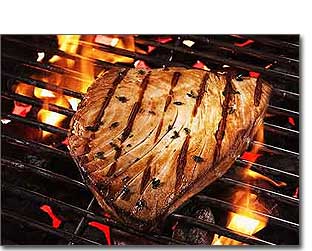
Whether you are talking about the glowing embers of a charcoal grill or the flickering flames of a gas grill, the fire provides you with several options for developing flavors, textures, and aromas. As you get better and better at mastering the fire to suit your needs, your ability will show in the food, and the ancient art of grilling will be more fun than ever before.
Direct heat means the fire is directly below the food. This arrangement works well for grilling thin, tender foods such as hamburgers, boneless chicken breasts, fish fillets, and sliced vegetables. These foods develop golden brown and delicious surfaces in the same amount of time that it takes to cook their centers Just right. Generally speaking, it is best to use direct heat for foods that need less than 20 minutes of grilling time.
Indirect heat means the fire is off to one side of the grill, or better yet, on opposite sides of the grill, and the food Is cooked over the unlit part. Large foods such as turkeys, prime rib, and pork shoulders do well in this arrangement, because the indirect heat cooks them evenly from all sides, allowing their centers to cook Just right before their surfaces are overdone. Generally speaking, it is best to use Indirect heat for foods that need more than 20 minutes of grilling time.
Sometimes a combination of direct and indirect heat will give you the best results. For example, bone-in chicken pieces will develop rich, smoky flavors and crispy skins when you grill them over direct heat for about 10 minutes. Then, if you move them over indirect heat, the meat at the center and near the bone will cook to a juicy, tender doneness before the skins get too dark. I call this second step "grill-roasting," because the grill works like an oven, with indirect heat penetrating from all sides rather than primarily from below.
Choosing direct heat vs. indirect heat is one thing. Another important decision is whether to use high, medium, or low heat [or any other heat level in between]. The recipes in this book recommend which temperature[s] to use, but if you are working with a charcoal grill with no knobs to turn, how can you tell the differences between the levels of heat? Ideally your grill has a thermometer mounted in the center of the lid.
High, medium, and low correspond to these temperature ranges on the thermometer:
A simple way to light any type of charcoal is to use a chimney starter - an aluminum cylinder with a handle outside and wire rack inside. Remove the top grate from your grill and set the chimney starter on the charcoal grate below. Fill the space under the wire rack with a few sheets of wadded-up newspaper or a few paraffin cubes. Fill the space above the rack with charcoal. Light the newspaper or paraffin cubes through the holes on the side. The coals will be glowing bright orange in 10 to 15 minutes. Wearing barbecue mitts, pour the coals carefully over the charcoal grate.
Note: Never place a hot chimney starter on the grass or deck. Set it on a heatproof surface, such as concrete, and keep children and pets away. Alternatively, light a few paraffin cubes in the middle of the charcoal grate. Build a pyramid of coals over the paraffin cubes. When the coals in the middle are lit, use long tongs to pile the unlit coals on top. When all the coals are glowing bright orange, arrange them on the grate.
The number of coals you need to start depends on the size of your grill. In most cases, you should start with enough to create a single layer of coals across the charcoal grate.
Diameter of Grill:
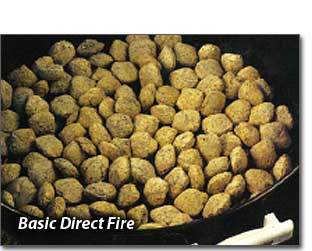 Use a long spatula or tongs to move the coals in whatever configuration you need. The most basic configuration is a i-zone fire, where you have even heat all the way across the grill. Notice that the coals have a light coating of grey ash. Wait until they reach this point before grilling.
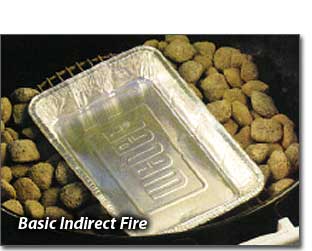 If you want the option of grilling over both direct and indirect heat, push the coals to the opposite sides of the grill and put a disposable drip pan in the middle [for long-cooking recipes, add water to the drip pan to keep drippings from burning]. The middle area is for indirect grilling. You will need about one-third fewer coals for this configuration.